




We believe Life begins at conception and ends at natural death and that Faith and Family are the foundation of civilised society. We defend life from conception to natural death, we conform to the teachings of the One, Holy, Catholic and Apostolic Church and we promote the traditional Family built on the lifelong union of one man and one woman for the purpose of bearing and raising children.
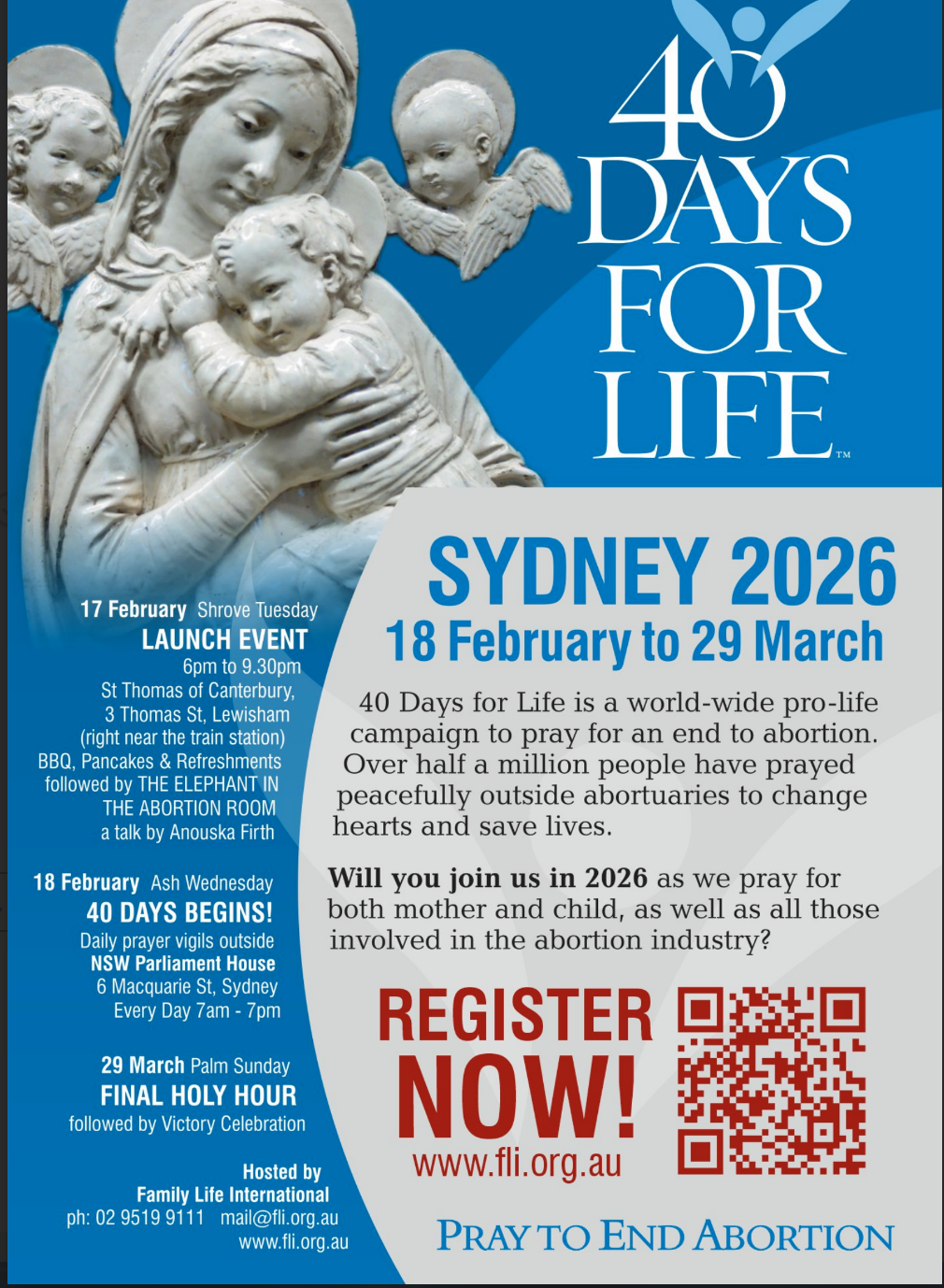
40 Days for Life 2026
Will you join us?
Will you join us?
Feature Video
Breaking the Cycle of
Addiction & Trauma of Abortion
by Anouska Firth
Addiction & Trauma of Abortion
by Anouska Firth
Witness for Life










“Against the Grain”
a podcast by Fr Ben Saliba
a podcast by Fr Ben Saliba
Oceania Catholic
Homeschooler
Homeschooler
Oceania Catholic Homeschooler exists to help parents educate their children in the Faith. We do this by sharing the real experience of homeschooling mums, and people who were homeschooled, so that all can learn a little bit more about authentic Faith-based education in the home. We also publish stories about activities and resources that may be of use to homeschoolers and others.




Why Homeschool?
It is our belief that the number of moral risks to children’s immortal souls is at such a level that homeschooling is the only real option. This might be controversial and many think it is beyond them, however we think that often it is the misunderstandings and the fear of the unknown that causes that reaction.
We intend to act as a facilitator for those approaching homeschool education to put families in touch with some of the excellent teachers now out of work due to “vaccine mandates.”
We have published five articles from homeschoolers at different stages highlighting both the benefits and the difficulties of homeschooling to help overcome many of the fears and misunderstandings used against it.
-
On Eagle’s Wings
By Donna Allen It’s been a bit more than a year now, since we engaged in a little social and educational experiment. A year since lockdowns and apartheid caused rifts in society and led to some serious free thinking about solutions. I have been a teacher for 28 years, a mother of a large […]
-
The goal of education: A timeless message for parents from the Lion of Münster
Published by “Voice of the Family” By John Smeaton | 18 January 2023 This is the first in a new series of articles, rooted in the teaching of Divini Illius Magistri, which seeks to assist parents in preparing their children to live as mature Christians in dangerous times. Today, a toxic world environment — […]
-
Why Homeschool?
Written by Marion O’Halloran Marion O’Halloran has been married to Brady for 19 years, has 6 children and has been Homeschooling for 14 years. Her father, Bernard Sadler, was one of the founding members of what is now Family Life International, Australia. I never intended to homeschool. As a young single woman, I thought for […]
-
A Love of Learning? Why Not.
Written by Emma Button Emma Button is a catholic home schooling mother of 8 children from Sydney. An architect by training, Emma has a passion for art and literature. She and her husband Sam have been married for almost 20 years. When I was growing up some of my friends were home schooled and […]
-
Homeschooling like Samwise
Written by Monica Aarts Monica Aarts is married for seven years and is a mother of four daughters, has been homeschooling her children for around three years. Homeschooling is not for the faint hearted. Before having children, my husband and I were determined to homeschool our future children so that they would not miss out […]