
27th July 2026
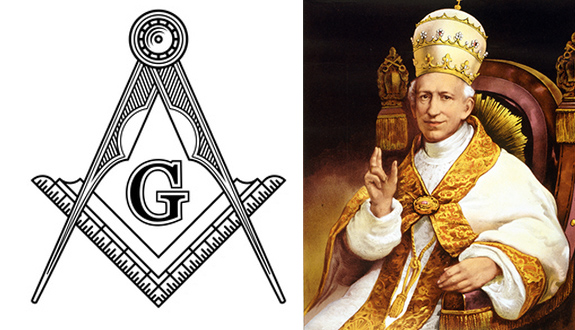
In recent decades a good deal of confusion has arisen in many countries as to whether Catholics who have joined Masonic lodges remain in good standing with the Church and are therefore able to receive her sacraments. The idea has become quite widespread that because the post-Vatican II Code of Canon Law no longer condemns Freemasonry by name or punishes its members with excommunication, membership in the ‘Craft’ is now quite acceptable for Catholics. For, we are told, modern Freemasonry is quite benign: it no longer plots against the Church and confines its activities to charitable works and the promotion of brotherly good will and human dignity. Surely no Catholic could object to that? And indeed, there is evidence that a good number of Catholics in many countries are not only active Freemasons but consider themselves in good standing with the Church and so habitually receive the sacraments.
Unfortunately, such a view does not accurately represent either the nature of Freemasonry or the post-conciliar Church’s official position regarding Masonic associations. So in this brief article I hope to dispel the main points of confusion currently surrounding this issue.
In the original Code of Canon Law promulgated in 1917, c. 2335 prescribed excommunication for membership in Masonic associations. This penalty was imposed in view of Freemasonry’s long tradition of anti-Catholic activity, but also because its relativistic world-view is incompatible with the Catholic faith. But in the revised Code promulgated by Pope St. John Paul II in 1983, the canon that specifically named Freemasonry was replaced by a more general one that states, “A person who joins an association that plots against the Church is to be punished with a just penalty” (c. 1374). Now, there is probably good reason to believe that quite a few lodges still do in fact strongly oppose the Catholic Church and work secretly (i.e., “plot”) to discredit her and destroy her influence as far as possible. However, for present purposes I will prescind from that supposition and simply consider the case of Masonic associations that do not engage in such deliberate anti-Catholic plotting. Will Catholic membership in such lodges now be acceptable?
The first point to make clear is the relation between the Church’s canon law and her doctrine of faith and morals. While the Church presupposes that every action proscribed as a punishable offence in canon law also violates one or more norms of her moral doctrine, the reverse is not true. Canon law has never set out to penalize every kind of sin, so that the deletion of a former canonical offence in the revised code by no means implies that the Church now judges the action in question to be morally acceptable from a doctrinal standpoint. More specifically, the fact that canon law no longer prescribes excommunication for membership in Masonic associations does not imply that the Church now regards such membership as being compatible with receiving the Eucharist. For while every mortal sin debars us from receiving Holy Communion until we repent and confess it, only a few such sins result in excommunication – a penalty that carries a number of disciplinary consequences in addition to exclusion from the Eucharist (cf. canon 1331).
Indeed, at the time when the current Code of Canon Law came into effect, Pope St. John Paul II approved and ordered to be published a ‘Declaration on Masonic Associations’, dated 26 November 1983, coming from the Congregation of the Doctrine of the Faith. The relevant part of this Declaration states that although the new Code does not mention Freemasonry by name,
“[T]he Church’s negative judgment in regard to Masonic associations remains unchanged, since their principles have always been considered irreconcilable with the doctrine of the Church and therefore membership in them remains forbidden. The faithful who enroll in Masonic associations are in a state of grave sin and may not receive Holy Communion.
“It is not within the competence of local ecclesiastical authorities to give a judgment on the nature of Masonic associations which would imply a derogation from what has been decided above.”[1]
The fact that this unqualified prohibition of membership in Masonic associations as a grave sin is still in effect was recently made clear by none other than Pope Francis and the Dicastery for the Doctrine of the Faith. This decision came in a ‘Note’ from the Dicastery dated 13 November 2023, responding to an inquiry from a Bishop in the Philippines – a country in which it appears many Catholics have enrolled in Masonic lodges. This document states:
“On the doctrinal level, it should be remembered that active membership in Freemasonry by a member of the faithful is forbidden because of the irreconcilability between Catholic doctrine and Freemasonry (cf. Congregation for the Doctrine of the Faith, “Declaration on Masonic Associations” [1983], and the guidelines published by the Catholic Bishops’ Conference of the Philippines in 2003). Therefore, those who are formally and knowingly enrolled in Masonic Lodges and have embraced Masonic principles fall under the provisions in the above-mentioned Declaration. These measures also apply to any clerics enrolled in Freemasonry.”[2]
The Dicastery also recommends in this ‘Note’ that at the pastoral level, the Filipino faithful be offered catechesis that explains the reasons for the irreconcilability between the Catholic Faith and Freemasonry.[3] Such explanations will no doubt be worthwhile in other countries as well; so hopefully the following observations will help to render more intelligible the Church’s continuing strict prohibition of membership in Masonic associations.
There are two essential features of Freemasonry that are irreconcilable with Catholicism: its belief system and certain of its practices that are not in harmony with the First and Second Commandments of the Decalogue.
The first point of contradiction lies in the fact that Freemasonry has an all-encompassing world-view that does not recognize Christianity as the full and unique Revelation of God, made known in Jesus Christ for the eternal salvation of the human race. Freemasonry does indeed allow membership to those professing any religion, including the Catholic faith, but treats all of them on an equal footing as different human approaches toward the mystery of the divine. The Catholic Church has always emphatically rejected this relativistic, anti-dogmatic approach to religion, which it has traditionally called ‘indifferentism’.
It might be objected that the Church has no objection to Catholics being members of many other organizations – charitable, sporting, and cultural associations, political parties, and so on – that make no distinctions based on the personal religious or philosophical beliefs of their members. So why, it might be asked, should membership in a Masonic lodge (assuming it is one that does not plot against the Church) be treated as uniquely unacceptable?
The difference is that these other associations which Catholics may freely join have goals that are limited to specific aspects of the temporal common good. Freemasonry, by way of contrast, has its own overarching understanding of the whole of reality, as does Catholic Christianity, so that these two worldviews, being very different, are by their very nature in competition with each other. And Catholics cannot be members of any association whose basic principles deny that their Church alone possesses and teaches the fullness of divinely revealed truth. Freemasonry embodies ethical and metaphysical doctrines similar to the rationalistic understanding of God known as deism, which was coming into vogue in Europe when modern Masonry was founded in London in 1717. The existence of a Supreme Being (referred to in Masonic tradition as ‘the Great Architect of the Universe’) is usually acknowledged, but this vaguely-defined entity is assumed never to have intervened in human affairs with any revelation as to how our personal and public life should be organized. Rather, Freemasonry teaches that humanity has been left to its own devices in building a just and brotherly world; and it insists in particular that human society and public life ought to be organized on the basis of purely secular or natural ethical principles, that is, disregarding any doctrines purporting to be supernaturally revealed. By way of contrast, it is a fundamental principle of the Church’s social doctrine that Catholics, especially the laity, should promote the universal kingship of Jesus Christ by striving “to infuse a Christian spirit into the mentality, customs, laws, and structures of the community in which one lives” (cf. Catechism of the Catholic Church, no. 2105, citing Vatican Council II, Decree on the Apostolate of the Laity, article 13).
In short, all Freemasons are expected to find their unity in, and to base their social and communal activities on, this all-encompassing naturalistic and secular worldview of the Masonic brotherhood, which is held to surpass or take precedence over their differing private religious beliefs.
The second point of incompatibility between Catholicism and Freemasonry derives from the fact that while the latter claims not to be a religion, its practices involve features characteristic of organized religions, such as solemn rituals and oaths taken at altars in buildings called ‘temples’. In the ‘Craft’ (or ‘Blue’) Lodges that are the most common ones today, initiation into each of their three degrees of membership requires the candidate to take a covenant oath, sworn at an altar, which symbolically evokes the shedding of his own blood. By this oath, sworn in the name of “Almighty God” with his hand on the sacred book of his preference (thus, for Christians, the Bible), the candidate invokes a death curse upon himself should he ever reveal Masonry’s secrets.
Now, it is always clearly explained to the candidate that this oath is not to be taken literally. Rather, it is to be understood symbolically or allegorically, and has the purpose of underlining the seriousness of the candidate’s undertaking to live according to Freemasonry’s ethical principles and guard its secrets. But in the first place, the Catholic Church has only ever allowed oaths whose wording is to be taken literally, so that there can be no possible doubt or ambiguity about the nature of the commitment that God is being called upon to witness. Secondly, even though they are intended as only ‘symbolic’ in meaning, the words used in these masonic oaths are in themselves deeply offensive to Christian ethics and sensibilities, since they solemnly express acceptance and approval of behaviour that directly violates the Fifth Commandment.[4] The Catholic Church has never permitted anyone to give a quasi-suicidal consent to being put to death outside of a lawful judicial process – in other words, to being murdered. The Catechism of the Catholic Church affirms, “Pledging oneself by oath to commit an evil deed is contrary to the holiness of the divine name” (no. 2152.) And voluntarily submitting to a death of that sort would be an evil deed. For in contrast (for example) to those many martyrs who have voluntarily accepted death rather than deny the faith, the Mason who swears this oath clearly implies that those committing this hypothetical murder would be justified in doing so because he, not they, would be the guilty party. And should a Catholic Freemason, in reply, insist all the more emphatically that in swearing the oath he does not truly mean what the words themselves mean, the more clearly he will be exposing the masonic oath as a false oath. And the Catechism teaches us, “Rejection of false oaths is a duty toward God. . . . A false oath calls on God to be witness to a lie” (no. 2151). A final point of incompatibility with Catholic norms is that, precisely because they are secrets not revealed to the uninitiated, the specific obligations that the candidate swears to abide by are not made known to him until after he takes the oath. But the Church has never approved such oaths or vows, which are analogous to signing a blank cheque. It is irreverence to the holy name of God if I solemnly call on him to witness my promise to do something as yet unknown to me, because it has deliberately been kept a secret.
In short, regardless of the masonic oath’s purely “symbolic” character, its evil wording and secretive character can in no way be reconciled with the profound reverence due to “the holiness of the divine name”. Therefore the Catholic who swears one or more of these unapproved oaths thereby seriously violates the Second Commandment, “You shall not take the name of the Lord your God in vain”.
Furthermore, admission to the third degree of Master Mason in ‘Craft’ (‘Blue’) lodges involves the enactment of the ‘Hiramic Legend’, in which the candidate undergoes a quasi-sacramental ‘death, burial and resurrection’ ceremony. This initiation ritual, which is a central feature of Freemasonry, parallels the sacrament of baptism quite closely, but is not meant to be associated with any specific world religion and includes no reference to faith in Jesus Christ as Saviour, or to divine revelation and supernatural grace as necessary for salvation. Rather, it is said to symbolize a commitment to moral self-improvement and, perhaps, a purely rational or philosophical hope of life after death. But the fact that the rite itself symbolizes bodily resurrection – a future state knowable only by revelation, not by reason alone – only confirms the religious character[5] of Freemasonry’s rituals, even if many Masons do not actually believe in bodily resurrection. Participation in a non-Christian ritual such as this is an offense against the First Commandment and constitutes the canonical crime of vetita communicatio in sacris: “prohibited communication in sacred things” (cf. Code of Canon Law, c. 1365).
Once Catholic Freemasons come to realize and understand that their membership in the brotherhood and participation in its rituals has been judged by their Church to be gravely sinful, they may find difficulty in coming to terms with this inherent contradiction within their current lifestyle. That may be especially true if, as active lodge members, they have been receiving Holy Communion in good faith under the mistaken impression that this is now permitted by the contemporary Catholic Church. However, it will not be a legitimate way out of this dilemma to tell themselves that, regardless of what the Church says, their own conscience still sees nothing sinful in Lodge membership, so that they can continue ‘in good conscience’ to approach the Eucharist without abandoning Freemasonry. Such a decision would not in fact be a genuine act of a Catholic conscience at all, but rather, a sinful act of dissent. For it would be a case of refusing that ‘religious assent of mind and will’ to the authentic teaching of the Roman Pontiff, even when he is not exercising his infallible teaching authority (cf. Vatican Council II, Dogmatic Constitution on the Church, Lumen Gentium, no. 25).
Let us pray that every Catholic in this situation will be able to find an orthodox priest, who in a spirit of pastoral patience and charity, will help him to understand more clearly the reasons for the Church’s prohibition of lodge membership, while withholding sacramental absolution until the penitent is ready to express true repentance for the aforesaid forbidden oaths and ritual acts, and a firm purpose of withdrawing altogether from Freemasonry. Should the penitent express concern that such withdrawal would violate one or more of the oaths he has already taken, any orthodox and well-instructed confessor will reassure him that such an oath was never valid in God’s sight, so that he is no way morally bound by it.
Anonymous Author is an American PhD qualified moral theologian
[1] Congregation for the Doctrine of the Faith: Declaration on Masonic Associations Nov 26, 1983 The official Latin text of this Declaration is to be found in Acta Apostolicae Sedis, vol. 76 (1984), p. 300.
[2] Dicastery for the Doctrine of the Faith: The Request of His Excellency, the Most Rev. Julito Cortes, Bishop of Dumaguete (Philippines) Regarding the Best Pastoral Approach to Membership in Freemasonry by the Catholic Faithful (13 November 2023)
[3] Ibid.
[4] The traditional language of this self-curse is shockingly graphic. The candidate for each successive degree of masonic membership swears that should he ever violate his oath, he will submit to procedures such as the following: “having my throat cut across and my tongue torn out by its roots,” “having my chest torn open and my heart plucked out,” and “having my body severed in twain and my bowels taken thence and burned to ashes”. (It is understood that some lodges have softened this violent language, while retaining the essential symbolism of being put to death as a penalty for breaking the oath.)
[5] A typical dictionary definition of “religion” is “a structured system of beliefs, practices, and worldviews, often involving the worship of a supernatural, sacred, or divine power”. Thus, belief in a God or gods of some sort is a common, but not essential, component of a religion. Freemasonry, which treats belief in a Supreme Being (the “Great Architect of the Universe”) as normative, even if not essential, for its members, fulfils the above dictionary definition of a religion. For it certainly embodies “a structured system of beliefs, practices, and worldviews”. Since the Catholic Church recognizes Buddhism as a religion (cf. Vatican Council II, Declaration Nostra Aetate, on the Relation of the Church to Non-Christian Religions, article 2) even though it is agnostic about the existence of God, it would be inconsistent of her to deny the same status to Freemasonry.