

6th October 2026
“This article was previously published on Substack.com. Mark Sutherland is the grandson of Dr Halliday Sutherland (1882-1960) and is the author of Exterminating Poverty: The true story of the eugenic plan to get rid of the poor, and the Scottish doctor who fought against it (with Neil Sutherland).”
How to make tired old ideas appear to be new and urgent.
Mark Halliday Sutherland
Previously published on Substack on June 17, 2026.
Please note: This article includes long quotations which may signal TL;DR. My intent is not to irritate you, dear reader, but to place the quotations in context. That, and an attempt to ensure that the words and their sources are preserved for a little while longer.
In my last article, we saw how Malthus was the prototype for predicting the doom that was named after him.
Malthusianism led to the adjacent ideas of Neo-Malthusianism, Eugenics and Euthanasia. In this article I will encompass all of these using the term “population controllers.”1
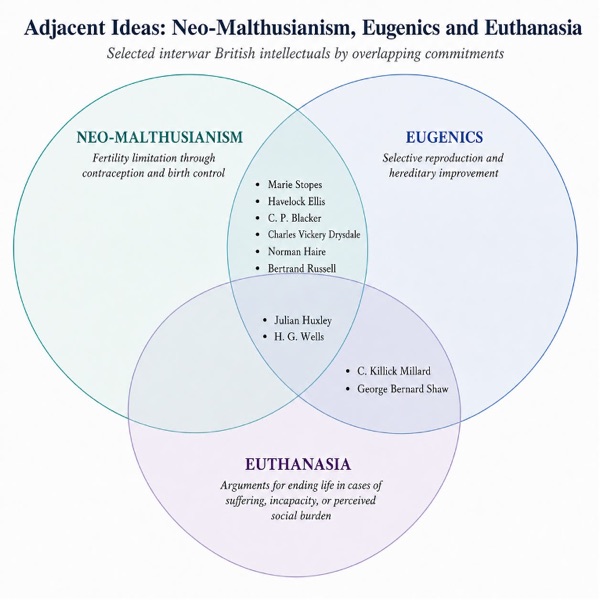
“New Bottles for Old Wine”
These ideas are not new and they can be found in previous eras. That said, their advocates disguise them in contemporary clothing so that they fit with the mores of the era in which they reappear.
For instance, compare Marie Stopes 1919 article for the Daily Mail:2
“Are these puny-faced, gaunt, blotchy, ill-balanced, feeble, ungainly, withered children the young of an imperial race? Why has Mrs. Jones had nine children six died, one defective? Nor is it for Mrs. Jones to take the initiative. Isn’t it for the leisured, the wise, to go to her and tell her what are the facts of life, the meaning of what she is doing, and what she ought to do? … Mrs. Jones is destroying the race!”
… with Julian Huxley’s 1946 UNESCO: Its Purpose and Its Philosophy:3
“Biological inequality is, of course, the bedrock fact on which all of eugenics is predicated. But it is not usually realised that the two types of inequality have quite different and indeed contrary eugenic implications. The inequality of mere difference is desirable, and the preservation of human variety should be one of the two primary aims of eugenics. But the inequality of level or standard is undesirable, and the other primary aim of eugenics should be the raising of the mean level of all desirable qualities. While there may be dispute over certain qualities, there can be none over a number of the most important, such as a healthy constitution, a high innate general intelligence, or a special aptitude such as that for mathematics or music.
“At the moment, it is probable that the indirect effect of civilisation is dysgenic instead of eugenic; and in any case it seems likely that the dead weight of genetic stupidity, physical weakness, mental instability, and disease-proneness, which already exist in the human species, will prove too great a burden for real progress to be achieved. Thus even though it is quite true that any radical eugenic policy will be for many years politically and psychologically impossible, it will be important for UNESCO to see that the eugenic problem is examined with the greatest care, and that the public mind is informed of the issues at stake so that much that now is unthinkable may at least become thinkable.”
Obviously, there are differences in the style of the speakers, the publications in which their words appeared, the context and the audience. Despite these differences though there is common ground in that they are both concerned with the “dead weight of genetic stupidity, physical weakness, mental instability and disease proneness”.
While the form changes, the substance does not. Nor do the solutions which involve:
- increased top-down control, usually by government or supranational bodies,
- the restriction of births, and
- the increase of deaths.
It is instructive to look at the iteration of these ideas in previous eras because the alien form makes it easier for us to see the substance.
Neo-Malthusianism
In 1924 the New Generation League was established by Neo-Malthusians who did not believe that the Malthusian League could be given a make-over. The league itself was dissolved in 1927. Since then, the movement has fragmented into its components, for instance, to the Family Planning Association for the advocates of contraception and for the enthusiasts of the Malthusian catastrophe, to repackaged Malthusianism including (and not limited to) the Club of Rome, Paul Erlich’s The Population Bomb, Global Warming and Climate Change.
Euthanasia
H.G. Wells was an early advocate of euthanasia. In 1901, he envisaged the brave men of the New Republic who would ensure “that only those who are fit to live freely in an orderly world-state should be permitted to live”.4
“The new ethics will hold life to be a privilege and a responsibility, not a sort of night refuge for base spirits out of the void; and the alternative in right conduct between living fully, beautifully, and efficiently will be to die. For a multitude of contemptible and silly creatures, fear-driven and helpless and useless, unhappy or hatefully happy in the midst of squalid dishonour, feeble, ugly, inefficient, born of unrestrained lusts, and increasing and multiplying through sheer incontinence and stupidity, the men of the New Republic will have little pity and less benevolence. To make life convenient for the breeding of such people will seem to them not the most virtuous and amiable thing in the world, as it is held to be now, but an exceedingly abominable proceeding. Procreation is an avoidable thing for sane persons of even the most furious passions, and the men of the New Republic will hold that the procreation of children who, by the circumstances of their parentage, must be diseased bodily or mentally—I do not think it will be difficult for the medical science of the coming time to define such circumstances—is absolutely the most loathsome of all conceivable sins. They will hold, I anticipate, that a certain portion of the population—the small minority, for example, afflicted with indisputably transmissible diseases, with transmissible mental disorders, with such hideous incurable habits of mind as the craving for intoxication—exists only on sufferance, out of pity and patience, and on the understanding that they do not propagate; and I do not foresee any reason to suppose that they will hesitate to kill when that sufferance is abused. And I imagine also the plea and proof that a grave criminal is also insane will be regarded by them not as a reason for mercy, but as an added reason for death. I do not see how they can think otherwise on the principles they will profess.
“The men of the New Republic will not be squeamish, either, in facing or inflicting death, because they will have a fuller sense of the possibilities of life than we possess. They will have an ideal that will make killing worth the while; like Abraham, they will have the faith to kill, and they will have no superstitions about death. They will naturally regard the modest suicide of incurably melancholy, or diseased or helpless persons as a high and courageous act of duty rather than a crime. And since they will regard, as indeed all men raised above a brutish level do regard, a very long term of imprisonment as infinitely worse than death, as being, indeed, death with a living misery added to its natural terror, they will, I conceive, where the whole tenor of a man’s actions, and not simply some incidental or impulsive action, seems to prove him unfitted for free life in the world, consider him carefully, and condemn him, and remove him from being. All such killing will be done with an opiate, for death is too grave a thing to be made painful or dreadful, and used as a deterrent from crime. If deterrent punishments are used at all in the code of the future, the deterrent will neither be death, nor mutilation of the body, nor mutilation of the life by imprisonment, nor any horrible things like that, but good scientifically caused pain, that will leave nothing but a memory. Yet even the memory of overwhelming pain is a sort of mutilation of the soul. The idea that only those who are fit to live freely in an orderly world-state should be permitted to live, is entirely against the use of deterrent punishments at all. Against outrageous conduct to children or women, perhaps, or for very cowardly or brutal assaults of any sort, the men of the future may consider pain a salutary remedy, at least during the ages of transition while the brute is still at large. But since most acts of this sort done under conditions that neither torture nor exasperate, point to an essential vileness in the perpetrator, I am inclined to think that even in these cases the men of the coming time will be far less disposed to torture than to kill. They will have another aspect to consider. The conscious infliction of pain for the sake of the pain is against the better nature of man, and it is unsafe and demoralizing for any one to undertake this duty. To kill under the seemly conditions science will afford is a far less offensive thing. The rulers of the future will grudge making good people into jailers, warders, punishment-dealers, nurses, and attendants on the bad. People who cannot live happily and freely in the world without spoiling the lives of others are better out of it. That is a current sentiment even to-day, but the men of the New Republic will have the courage of their opinions.”
Wells’ fellow Fabian G.B Shaw also didn’t want to punish anybody:
“I object to all punishment whatsoever. I don’t want to punish anybody, but there are an extraordinary number of people who I want to kill. Not in any unkind or personal spirit. But it must be evident to all of you, you must all know half a dozen people at least, who are no use in this world; who are more trouble than they are worth. And I think it would be a good thing to make everybody come before a properly appointed board just as he might come before the income tax commissioners and say every five years or every seven years, just put them there, and say, sir or madam, now will you be kind enough to justify your existence? If you can’t justify your existence; if you’re not pulling your weight in the social boat; if you are not producing as much as you consume or perhaps a little more, then clearly we cannot use the big organization of our society for the purpose of keeping you alive, because your life does not benefit us, and it can’t be of very much use to yourself.”
The Voluntary Euthanasia Legalisation Society was founded by Dr Charles Killick-Millard and others in 1935.5 In the aftermath of World War II, it became the Voluntary Euthanasia Society. This was changed to EXIT in the 1970s. From the 1980s it was the Voluntary Euthanasia Society, then in 2006 it became Dignity in Dying.
The form changes while the substance persists. In our times, who would not advocate dignity in dying?
Of course, the devil is in the details, but there are indications from Canada’s MAID program that euthanasia is being offered as an alternative to dignity in living. As government budgets tighten, time will tell whether spending money to save lives will morph into spending lives to save money.6
Eugenics
The Eugenics Education Society was founded by Sybil Gotto in 1907. In 1926 it changed its name to the Eugenics Society. World War II gave the movement a PR problem and membership of the Society began to fall. The solution, adopted in February 1960, was to: “pursue eugenic ends by less obvious means, that is by a policy of crypto-eugenics, which was apparently proving successful with the US Eugenics Society.” You might call me a nit-picker, but “crypto” comes from the Greek for “secret” not “less obvious”.7
In 1964 the society it held a symposium on Biological Aspects of Social Problems. Such was its success, that it was followed symposia on Genetic and Environmental Factors in Human Ability (1965), Social and Genetic Influences on Life and Death (1966), and Genetic and Environmental Influences on Behaviour (1967). At the end of 1968, the society ceased publication of the Eugenics Review and replaced it with the Journal of Biosocial Science.
The recommendation to change the name of the society to something “less evocative” was not adopted until 1989 when it became the Galton Institute. In 2021 it changed its name to the even-less-evocative Adelphi Genetics Forum.
Eugenics in the early Twentieth Century is particularly useful because eugenicists did not mince their words. In an era in which the poor did not have the vote, the social caste system was more rigid, and media and communication was less far-reaching, they didn’t need to. They frequently displayed their materialism and their disdain for humanity as a badge of honour.
In our times, the advocates of eugenics are much more guarded, not least because of the negative consequences of advocating eugenic ideas. We saw this following the publication of Toby Young’s The Fall of Meritocracy in The Quadrant in 2015 and in the resignation of Andrew Sabisky in 2020.8
Time and again the old ideas are repackaged and everything old becomes new. Tired, old, pessimistic ideas that didn’t work last time appear to be new and urgent. A new generation of dupes is found to earnestly parrot: “We. Have. To. Act. Now!”
And, as we will see in Part 2, the actions they advocate are amongst the worst ideas in history.