

6th August 2026
Written by Archbishop Julian Porteous
Published on “Grace & Truth”
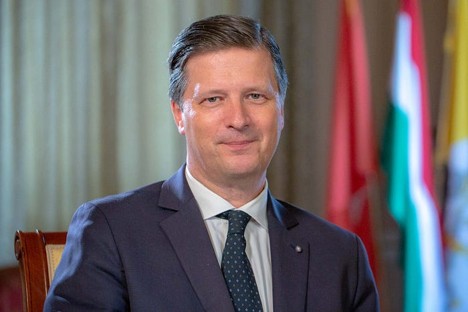
Eduard Hapsburg belongs to the renown Hapsburg dynasty, one of the principal sovereign dynasties in Europe since the thirteenth century. His official title is Archduke Eduard of Austria.
From 2015 he served as Hungary’s ambassador to the Holy See, concluding his mission in 2025. He is married and has six children. He is a committed Catholic.
He has written two books in which he explores the traditions which have informed the Hapsburg dynasty.
At the heart of these traditions is the Catholic faith and a belief in the centrality of family.
The first book, published in 2024, is entitled The Habsburg Way. 7 Rules for Turbulent Times. In this piece I would like to present some of the seven rules that Eduard Hapsburg proposes in his book. A second piece will present some of the insights of his second book, Building A Wholesome Family in a Broken World: Habsburg Lessons from the Centuries.
Eduard draws on stories from his family line. The Hapsburg dynasty contains many deeply religious members who have lived lives of holiness. Charles I of Austria, the last emperor of Austria-Hungary, was beatified by the Church in 2004. Of course, as in any family, there are also members who fall far short of its standards.
His first rule declares unapologetically: “Get married and have lots of children”. For a politically engaged royal family marriage was a way of forming alliances and avoiding wars. Thus, marriages were often arranged for strategic purposes.
However, Eduard explains that marriage “does require being with someone who shares your values, ideas, faith, and outlook”. He further comments, “I will add this additional thought: Because the Catholic faith provides such a deep spiritual foundation, it facilitates the formation of the deepest bond between spouses. Precisely because the Catholic faith is stable, it creates stability in marriages”.
That said, not all marriages over the long history of the Habsburg dynasty worked out as smoothly as others, and the author concedes that some were “a catastrophe and a silent martyrdom”. Despite this he returns to his conviction that “common faith and values form the best foundation for a happy marriage”. He comments that while romance can be wonderful it “is perhaps slightly overrated in our times.”
The second of his “rules” is to be Catholic. He says that the “Habsburgs were and, for the most part, still are Catholic”. From its earliest days the Catholic faith formed the identity and guided the lives of the heads of the dynasty. He comments that this faith enabled them to defend themselves against powerful movements like the Reformation and the Enlightenment. Eduard acknowledges that this faith is not just an intellectual matter but embraces forms of popular piety like “processions, rosaries, novenas, devotion to the Sacred Heart”. It is a faith that is to be lived out in daily life in a practical way.
He comments, “After eight hundred years of the intimate Habsburg presence in European politics, members of our family are still putting their faith first and making it the centre of their lives. Even if many Habsburg rulers were imperfect Catholics, Christ came to save sinners. And that is a very hopeful thought.”
Moving to his fifth rule Eduard presents the idea that “Those who don’t know where they come from do not know where they are heading because they don’t know where they stand.” He adds, “Knowing who you are gives you sovereignty over yourself. It will give you confidence not to be swayed by fleeting fads but to follow the truth about yourself and about God”.
This is very wise advice in a world which has atomised the individual and whose catchcry is “create yourself” and “fulfill your potential”. We stand in a family line, in a tradition, which offers identity and carries values. The modern desire to know where we come from points to the important of knowing our true identity and embracing traditions of our family. We don’t have to invent ourselves. There is much in our heritage that can be an inspiration as well as a sense of identity.
In an earlier point (Rule 4) Eduard Hapsburg speaks about standing for law and justice. He states that those in the nobility should take on the responsibility to serve and put one’s own interests in second place. He emphasises that life should be focussed on what one can contribute to the common good. It should not be a self-centred effort focussed on personal achievement.
He says that “respect for the law is an essential responsibility of the active monarch. A poignant example is Charles V, who looked at the people of the New World not as servants to be exploited, but as subjects to be treated fairly. He once wrote that the indigenous people “are our responsibility, for the honour of God and the sake of justice”.
In his final rule he speaks of “dying well”. He explains that living well flows into dying well, and the wish to die well leads to living well.
He quotes examples of his forebears working for noble causes.
He gives the example of Otto von Habsburg, the head of the house who died in 2011, who devoted his life to fostering a vision of a united Europe.
Eduard Hapsburg offers his thoughts on key principles or “rules” which can assist us in these “troubled times”. His insights, examples from his family, and his deep personal conviction offer a roadmap for us as we all try to navigate the troubled waters of our times. These “rules’ provide a checklist on how we have established the priorities by which we live.